
· Mira Chandran
How to Use a Singing Bowl: Your First 10 Minutes
Every beginner I teach makes the same two mistakes in their first ten minutes: they grip the bowl like a mug, and they circle the rim like they're stirring coffee. Fix those two habits and the singing bowl becomes one of the most forgiving instruments you can learn. This guide walks you through a complete first session on a Nadam Tibetan singing bowl — hammered brass with engraved mantras, mallet and cushion included, from $39.95 — from your first strike to a steady, unbroken hum. Everything here works at any of the seven diameters; I have written it around the 3.1 in starter bowl because that is what most first sessions happen on.
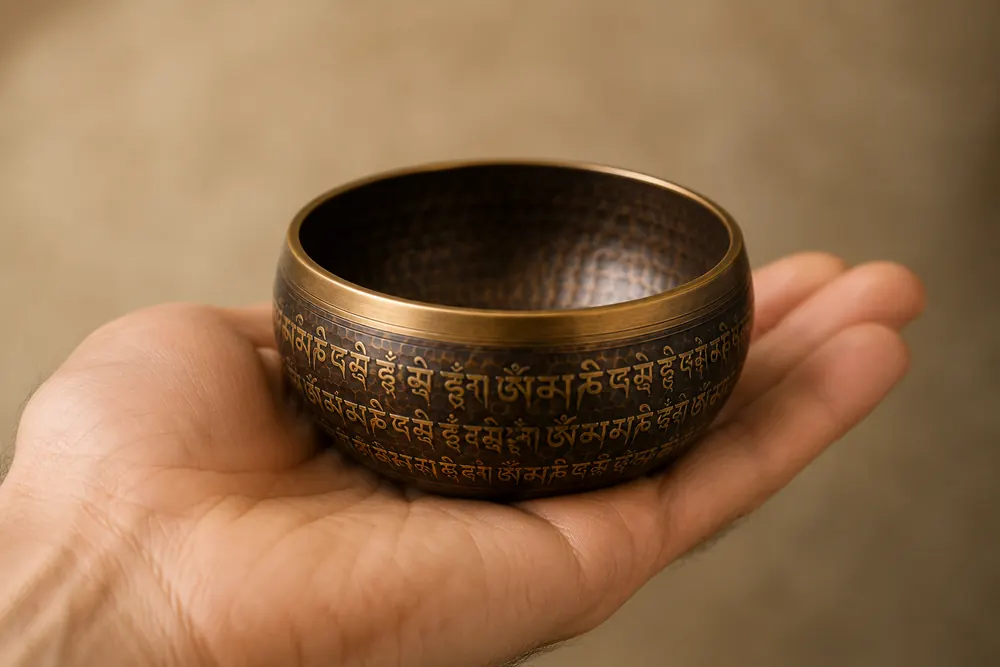
Hold the bowl on a flat, open palm
A singing bowl's voice lives in its walls, not its base. When you strike the rim or circle it, the walls flex in tiny waves, and anything touching them — curled fingertips, a cupped hand, the edge of a bulky sleeve — soaks up that motion before it can become sound. So the rule is simple: bowl on the flat of your palm, fingers straight and relaxed, thumb resting alongside the base rather than hooked over the rim.
Diameter of the smallest Nadam bowl (8 cm) — small enough to rest on an open palm without strain. From 4.9 in up, most players set the bowl on its cushion instead
— Nadam dimension sheet, 2026
At that size the bowl sits comfortably on almost any hand, which is exactly why I point beginners toward it. If holding it still feels fidgety, do what I have students do at sound baths: set it down. The 3.1 in starter set ($39.95) pairs the engraved bowl with a yellow silk cushion and a double-ended mallet, and it plays beautifully on a tabletop. The wider bowls in the range are meant to be played that way from the start.
The strike: your first clean tone
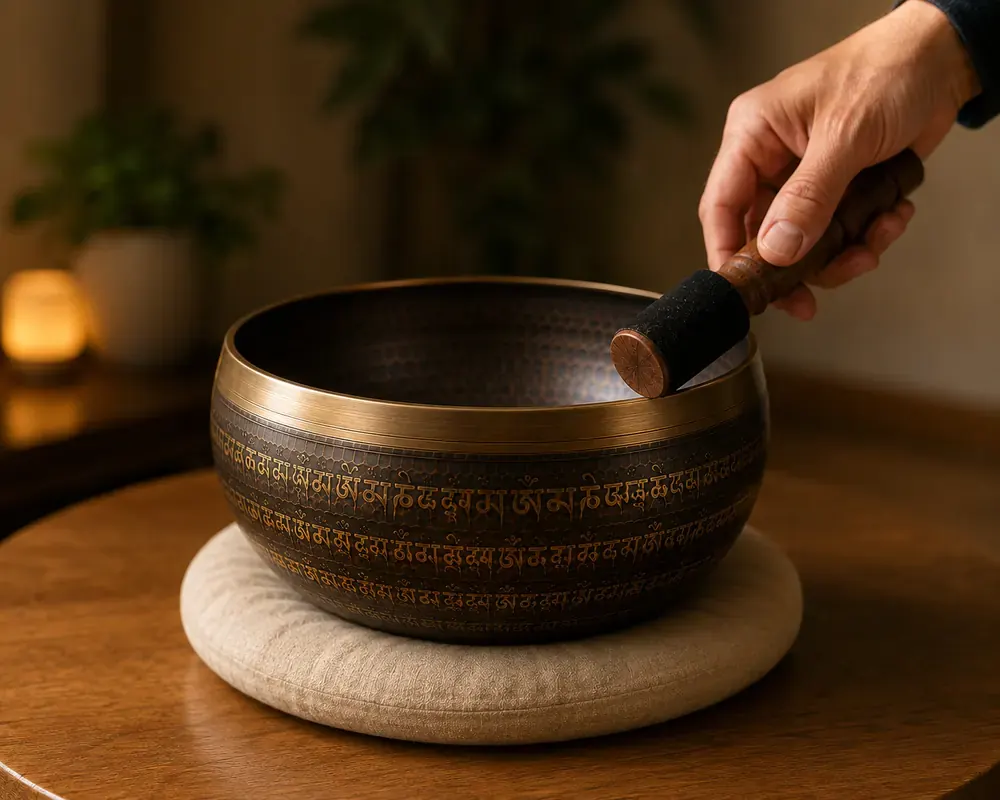
The strike is how you meet the bowl, and it deserves two full minutes of your first session. Hold the wooden mallet low and loose, the way you'd hold a pen you're about to set down. Tap the outer wall just below the rim, at a slight angle, and let the mallet rebound on its own — leaving it pressed against the metal after the strike is like putting a finger on a guitar string. You're not ringing a doorbell; a soft tap on hammered brass gives you more tone than you expect. Strike once, then listen all the way down to silence. That slow fade is the sound you'll learn to sustain next.
Rim singing: pressure beats speed
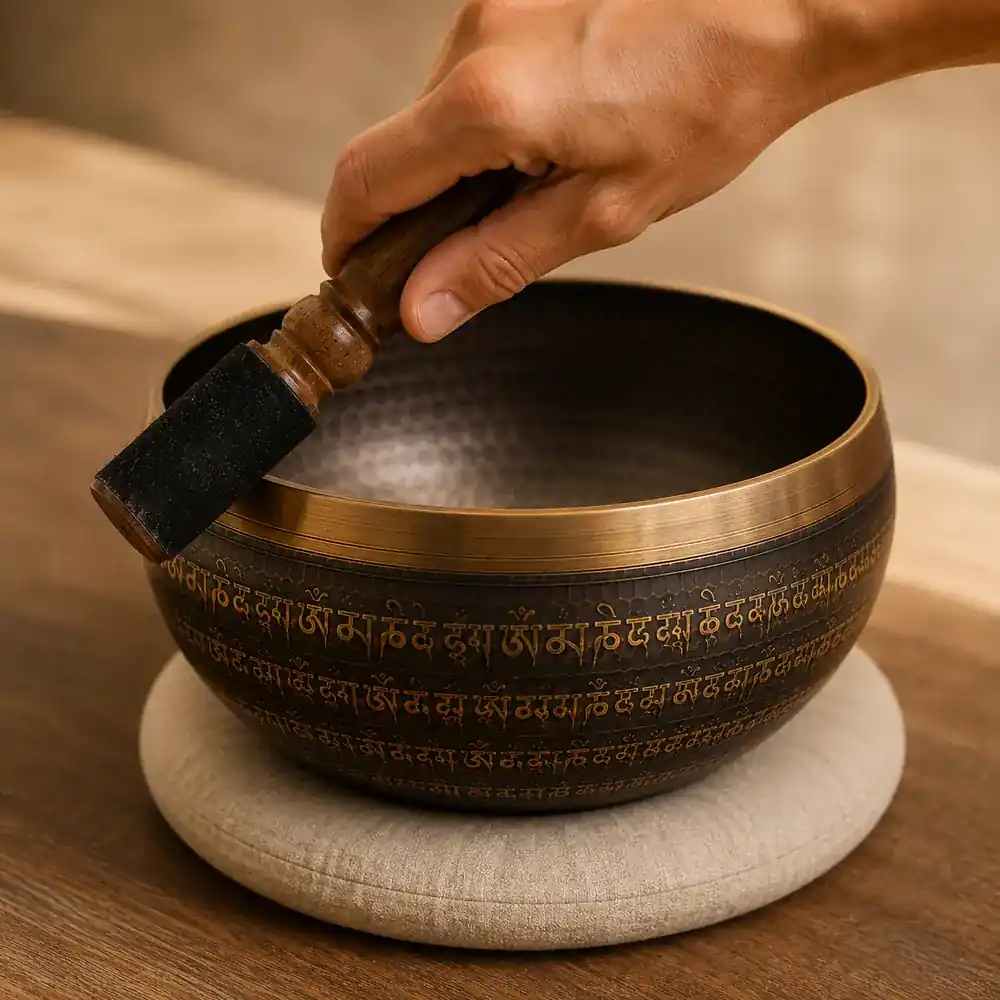
Rim singing runs on friction. As the mallet travels around the rim, it grips and releases the metal in tiny pulses, and those pulses stack into one continuous hum. That's why pressure, not speed, is the engine: without firm contact there's nothing for the friction to build on. Press the mallet into the outer rim as if you were drawing a thick, deliberate line with a crayon. Keep the mallet vertical, aim the pressure at the center of the bowl, and circle from your shoulder rather than your wrist, at an unhurried pace. Expect nothing for the first lap or two — the hum blooms gradually, then seems to carry itself.
Length of the double-ended mallet in the 3.1 in starter set (12.5 cm) — wood on one end for bright strikes, leather on the other for warmer rim work
— Official dimension sheet, 2026
That double-ended mallet gives you both voices in one tool: the wood end is bright and quick to speak, the leather end warmer and more forgiving. If you find yourself preferring the leather sound, a dedicated leather mallet is a worthwhile early upgrade.
Why your bowl squeaks at first (and how to stop it)
First, relax: the squeak is the technique, not the bowl, and everyone starts there. Here's what I listen for when a student's bowl squeals in class:
| What you hear | Likely cause | The fix |
|---|---|---|
| High squeal over the hum | Circling too fast with too little pressure | Slow the lap by half and press harder into the rim |
| Rattle or chatter | Mallet bouncing off the rim | Keep constant contact; grip lower and hold the mallet vertical |
| Tone dies after a lap or two | Fingers curled against the walls | Flatten your palm; make sure nothing touches the sides |
| Friction noise, no tone | Starting from a cold, still rim | Strike first, then circle into the ringing tone |
If the squeal won't quit on the wood end, switch to leather. Leather grips the rim more gently and forgives the small wobbles in pressure that bare wood turns into noise. The small leather mallet (5.1 × 1 in, $14.95) is sized for the 3.1 to 4.3 in bowls and is the most forgiving tool a beginner can own; on the 5.9 and 6.7 in bowls, reach for the large head instead.
Posture, breath, and where to practice
Your arm is about to draw hundreds of small circles, so give it room. Sit with your spine tall and your shoulders down, and keep your elbow away from your ribs so the sweep stays smooth. If your arm tires, move the bowl to its cushion on a table — nothing about the technique changes. Then time your breath to the laps: a long, slow exhale as you circle steadies the hand more reliably than concentration does. As for the room, quiet and hard-surfaced flatters the tone, while thick carpet and heavy cushions swallow it.
Year an observational study reported reduced tension, anger and fatigue after Tibetan singing bowl meditation sessions
— Goldsby et al., Journal of Evidence-Based Complementary & Alternative Medicine, 2017
That calm is what this practice points toward — not a medical treatment, but a reliable cue your body learns to answer. Many practitioners use a single bowl to open a relaxation or mindfulness routine; once your hum is steady, our singing bowl meditation guide shows you how to build one.
Three progressive exercises for your first 10 minutes
Here's the exact sequence I give first-timers. Run it start to finish and you've touched every core skill.
| Exercise | Time | What it trains | You've got it when |
|---|---|---|---|
| 1. Strike and fade | 2 min | Ear and mallet control | You can hear the exact moment the tone disappears |
| 2. Strike, then sing | 4 min | The transition into rim singing | The strike's ring carries into the hum with no gap |
| 3. The unbroken hum | 4 min | Steady pressure and patience | The tone holds level for a full minute |
Strike and fade. Strike the rim, close your eyes, and follow the tone until you honestly can't hear it anymore. Most beginners give up on the note early; the tail of the fade is where your ear sharpens fastest.
Strike, then sing. Strike once, and while the ring is still alive, bring the mallet to the rim and start circling. The vibration already in the walls gives the friction something to grab, so the hum arrives sooner. It's the single most useful beginner shortcut I teach.
The unbroken hum. Circle continuously and keep the volume level — no swells, no dropouts. When your attention drifts, your pressure drifts, and the tone tells on you instantly. That immediate feedback is the whole charm of practicing with a bowl.
Average rating across 105 verified purchases of the 3.5 to 6.7 in bowls
— Verified buyer feedback, verified order history, 2026
A forgiving bowl makes those ten minutes far easier, which is why every bowl we sell gets played — struck, sung, sustained — before it earns a place in the catalog. You can read exactly how we test.
After your first 10 minutes
Consistency beats duration: the same ten minutes daily will do more for your tone in a week than an hour every Sunday. When the hum starts arriving on the first lap, fold it into something bigger with our complete singing bowl meditation guide, and browse buyer photos and reviews to hear how other first-time players describe the sound. Still choosing your gear? Every order ships with free shipping (6-10 business days) and a 30-day money-back guarantee, so a squeaky first week costs you nothing but practice time. You'll find more beginner guides on the Nadam blog, and the story behind the brand on our about page.

Mira Chandran · Sound practitioner & product lead at Nadam
Mira has been leading small-group sound baths for years. She plays every size Nadam sells — strike tone, rim singing, sustain, how the bowl sits on its cushion — before that model earns a place in the catalog.