
· Mira Chandran
How to Set Up a Sound Bath at Home
A sound bath is a stretch of time where sound is the only thing on the agenda. You lie down or sit, someone plays slow resonant tones, and your attention gets a rare chance to follow a single sound all the way from strike to silence. One good bowl is all it takes, and it is how most people who keep the habit started. I have led small-group sound baths for years, and the sessions people remember are rarely the loudest or the best equipped. They are the ones where the room stayed calm, the pace stayed slow, and nobody rushed the silence at the end.
Below is the exact home setup I recommend: a dedicated corner, one bowl, and a twenty-minute sequence that works for one to three people.
One Bowl Is Enough — Ignore the Gatekeeping
Shop around and you will meet the same instrument under three names: singing bowls, sound bath bowls, and sound healing bowls. The label shifts with the marketing; the object is the same — a brass bowl you strike or ring with a mallet. One point of honesty before we go further: at Nadam we describe what these bowls do in terms of relaxation and focus, not medicine, and this guide stays inside that line.
The gatekeeping usually starts with gear. You will read that a proper sound bath requires a graduated set of bowls, a gong, and a weekend certification. It does not. A sound bath requires a quiet room, a listener, and one instrument played with patience. More bowls add color and range, and they are a lovely upgrade later — but they are an upgrade, not an entry ticket.
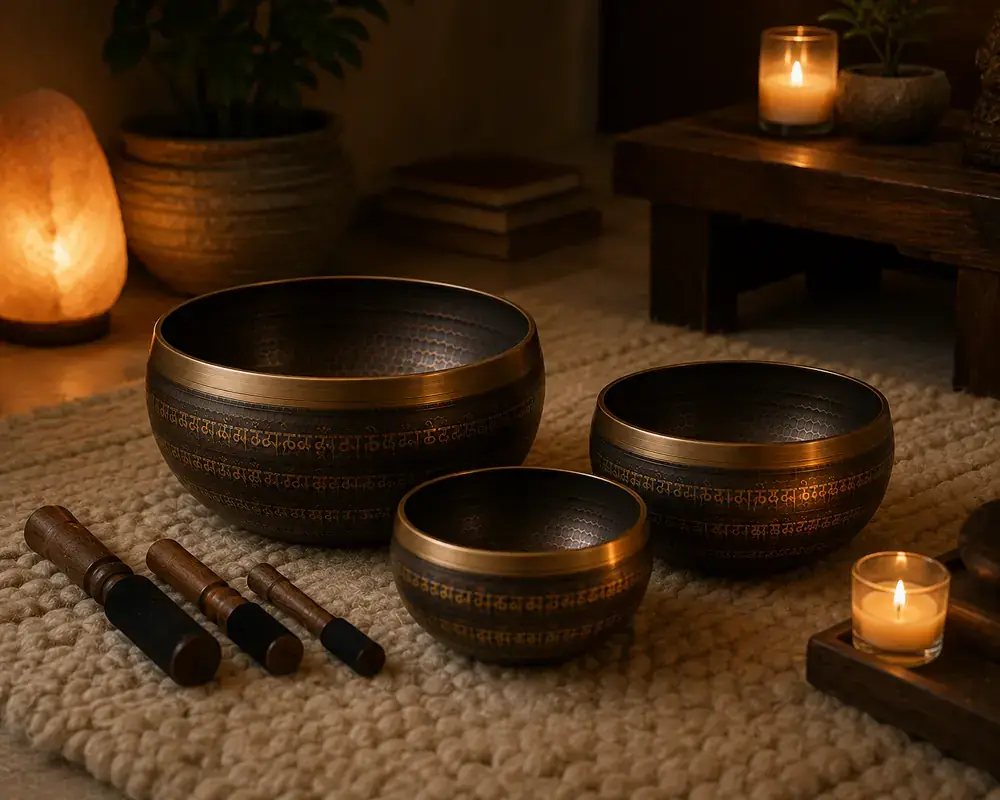
Our Tibetan singing bowls — hand-hammered brass with engraved mantras, seven diameters from 3.1 to 6.7 in — ships with a wood mallet, so the box at your door is already a complete starter kit. It produces the three sounds every session is built from: a clear strike tone, a sustained rim tone (the "singing"), and the long fade between them. If rim technique is new to you, our singing bowl meditation guide walks through it step by step.
average rating across 105 verified purchases of our 3.5 to 6.7 in bowls
— verified buyer feedback, verified order history, 2026
Build Your Sound Bath Corner: Mat, Cushion, Light
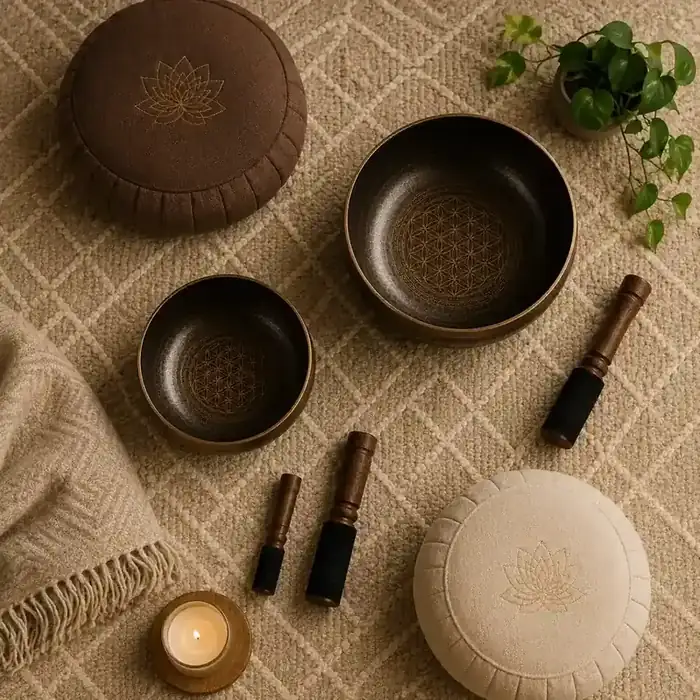
A sound bath competes with the rest of your home for space and attention, so give it a spot of its own — a bedroom corner, the end of a hallway, the quiet side of a living room. Three things make the corner work:
The mat. One yoga mat, folded blanket, or thick rug per listener. Lying on a bare floor pulls attention to your shoulder blades instead of the sound, and cold floors end sessions early. Add a light blanket for each guest; body temperature drops when you lie still for twenty minutes.
The cushion. The bowl needs to sit where its rim can vibrate freely — on a small cushion or on your flat palm, never gripped by the sides. Anything that touches the rim mutes it. This is exactly why our Singing Bowl Set pairs the bowl with a silk cushion sized to match: the bowl rests on the padding while the rim stays completely clear.
The light. Overhead lights keep the room in "task mode." Switch them off and use one warm source at floor level — a small lamp or a candle placed where nobody will reach over it. Low, warm, slightly dim: enough to see the bowl, not enough to read by.
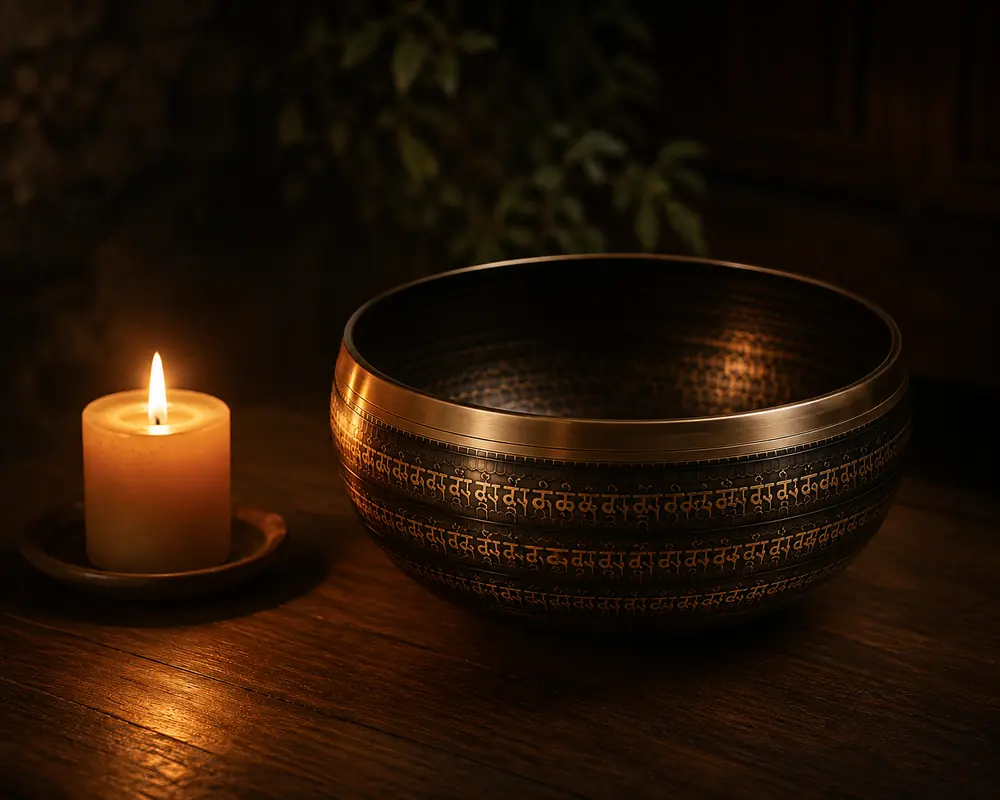
Two small habits finish the corner. Leave it set up between sessions if you can, because friction is the quiet killer of home practice. And leave phones in another room — a single buzz can undo ten minutes of settling.
A 20-Minute Sound Bath for One to Three People
This is the sequence I use for small sessions at home. It needs one bowl, one player, and no talking once it starts.
| Minutes | What the player does | What to listen for |
|---|---|---|
| 0–2 | Everyone settles. No sound yet — the player takes a few slow breaths with a hand resting near the bowl. | The room itself: hum of the house, your own breathing slowing down. |
| 2–5 | Strike phase. One gentle strike on the rim's outer edge, then wait until the tone fades completely before the next. | How long the fade actually lasts — most people underestimate it. |
| 5–12 | Rim singing. Steady, slow circles around the rim with even pressure, holding the tone at a comfortable volume. | The moment the tone becomes continuous and seems to detach from the bowl. |
| 12–17 | Slow strikes with widening gaps. Each strike a touch softer, each silence a little longer than the one before. | The silences — they start to feel like part of the music. |
| 17–20 | Pure silence. No sound at all, then a quiet cue: "wiggle your fingers and toes, sit up slowly." | Nothing. That is the point. |

For two or three listeners, lay the mats in a loose fan with heads toward the bowl, about three to six feet (1–2 m) away. The player sits at the center on a folded blanket, bowl on its cushion or palm. Keep your movements slow even between phases — in a quiet room, a rushed gesture is as loud as a cough. If you want to go deeper on strike placement and rim pressure, the full meditation and playing guide covers both in detail.
self-reported states — tension, anger and fatigue — that participants described as reduced after Tibetan singing bowl meditation sessions in an observational study
— Goldsby et al., Journal of Evidence-Based Complementary & Alternative Medicine, 2017
Worth saying plainly: that study is observational, and we cite it as context, not as a promise. A sound bath is a relaxation practice, not a treatment — what it reliably offers is twenty minutes where nothing is asked of you.
When to Play: Evenings and Transitions
The best time for a sound bath is a boundary — a moment when one part of the day ends and another begins. Evening is the classic slot: the dishes are done, the lights go warm, and twenty minutes of slow tones marks the shift from doing to resting. Played at the start of a wind-down routine, the bowl becomes a signal your whole household learns to recognize.
Transitions work just as well. The minutes right after you get home, before you touch anything with a screen. The pause between finishing work and starting dinner when your home office is also your kitchen table. Before journaling, reading, or stretching, when you want a clean line between the noise of the day and something quieter.
And not every session needs the full twenty minutes. One strike, one complete fade, three slow breaths — that is a sixty-second reset between tasks, and it keeps the bowl part of your day rather than an ornament on a shelf.
Common Mistakes: Too Loud, Too Fast
Playing too loud. A hard strike doesn't make a bigger sound; it makes a harsher one — a metallic clang that spikes and dies instead of blooming. Strike as if you were tapping a friend's shoulder, then wait. If your tones still feel sharp-edged, a leather-head mallet is the classic fix: our leather mallets come in three sizes, and the small 5.1 in head is matched to the 3.1 to 4.3 in bowls, softening the attack while keeping the tone full.
average rating across 23 verified buyer reviews for our hardwood and leather mallets
— verified buyer feedback, verified order history, 2026
Rim singing too fast. Speed is the number one reason a bowl seems slow to sing: the mallet skips and chatters instead of building a tone. It is the single most common thing new players get wrong, and it has nothing to do with the bowl. The cure is almost always slower circles with steady, even pressure, letting the tone grow over several rotations instead of forcing it in one.
Setting the bowl on a bare hard floor. The rim gets damped, the sound thins out, and the bowl can creep across the boards as you play. Cushion or flat palm, always.
Filling every silence. Beginners treat the fade as dead air and rush to the next strike. The fade is the sound bath. If a tone dissolves and the room holds its breath for ten seconds, that is the session working.
Treating it as a performance. Nobody is scoring you. A wobble in the tone matters less than the pace you keep. This is the same standard we apply before anything earns a listing — every bowl we sell has to sing under a slow, patient hand, exactly as described in how we test.
Our Set as a Starting Point
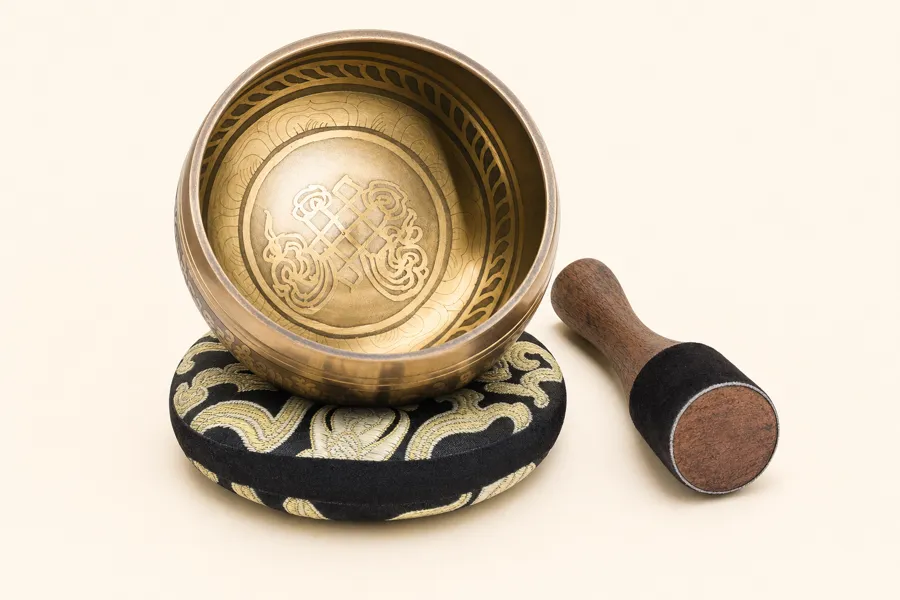
Everything in this guide is written around the hand-hammered brass bowls we make. If you would rather not assemble the pieces yourself, the set is the shortcut we built for exactly this use: an engraved bowl, the cushion that keeps the rim free, and a 4.9 in (12.5 cm) double-ended mallet — wood on one side for bright strike tones, padded on the other for rim singing. The 3.1 in starter set carries a Flower of Life motif engraved inside its base; the larger bowls carry rows of Tibetan mantras across the outer wall, with one of three motifs struck inside the base.
average rating across 361 verified reviews for the complete Singing Bowl Set
— verified buyer feedback, verified order history, 2026
You can read the verified buyer reviews to see how these bowls land in real homes, and the Nadam story explains why we sell one instrument in seven sizes instead of thirty unrelated products. Practical details are simple: free shipping with delivery in 6–10 business days, a 30-day money-back guarantee, and secure Stripe checkout. Not sure which diameter suits your corner? Write to us — we answer personally.

Mira Chandran · Sound practitioner & product lead at Nadam
Mira has been leading small-group sound baths for years. She plays every size Nadam sells — strike tone, rim singing, sustain, how the bowl sits on its cushion — before that model earns a place in the catalog.