
· Mira Chandran
Hand-Hammered vs Machine-Made Singing Bowls: How to Tell the Difference
Every listing you scroll says the same three words: handmade, authentic, artisan. Some of that is true, some is marketing, and a lot sits in between. I play every bowl that enters the Nadam catalog before it earns a page — strike tone, rim response, sustain — and the gap between hammered and machine-made metal is something you can hear in seconds and see from across the room once you know what to look for. Here is what the metal itself shows: how each type is made, why they sound different, how to spot hand work with your own eyes, and what you should reasonably pay.
What Hand-Hammered Actually Means (and What It Usually Means Today)
For generations, a singing bowl began as a heated blank of metal, raised and shaped stroke by stroke until a bowl emerged. Nothing about that process is quick. The hammer does the forming, the tuning, and the decorating all at once, which is why a genuinely hand-raised bowl is a small event: it carries the maker's rhythm in its walls, and no workshop can produce two identical pieces.
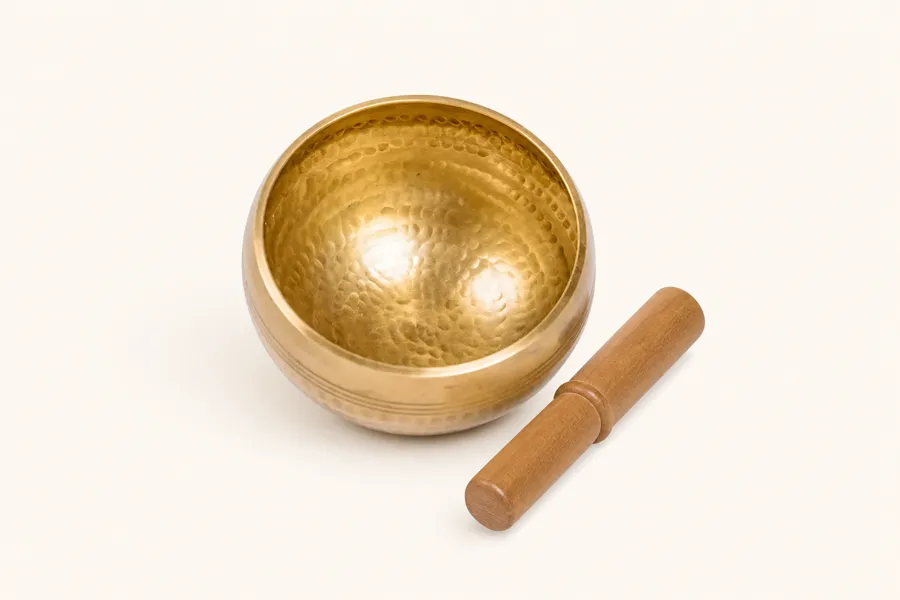
The market you are actually shopping in works differently. Most bowls sold today are brought to a clean starting geometry and then hammered, textured, engraved and polished by hand, one piece at a time. That hand stage is where the character comes from: the hammer sets the wall thickness, and the wall thickness sets the voice. So the useful question is never whether the word handmade appears in a listing, but how much of the bowl a person actually worked.
Our position is simple: say precisely what a thing is. A Nadam bowl is brass that is hammered, darkened and engraved by hand, piece by piece, with rows of Tibetan mantras set in gold across the outer wall — that is the wording on our Tibetan singing bowl page, because that is the object in the box. If a seller cannot tell you which tier their bowl belongs to, assume the lowest and price accordingly. More on how we choose what to sell is on our about page.
The Sound: Layered Overtones vs One Clean Note

The physics is intuitive. Hammering leaves the wall of a bowl minutely thicker here, thinner there. Strike it, and those regions vibrate at slightly different rates, so the fundamental arrives wrapped in overtones that swell, beat against each other, and fade at their own pace. That slow interference is the shimmer people describe after a sound bath — a tone that feels alive rather than merely played.
A machine-made bowl has walls of near-perfect uniformity, so the energy pours into fewer partials. The voice is cleaner, steadier, and repeatable: strike it a hundred times and you get the same note a hundred times. That is not a flaw. If you want several bowls that match one another, uniformity is exactly the quality you are buying.
Two things worth knowing. First, you will not find a frequency printed anywhere in this article: hand-worked metal makes every piece individual, and that individual voice is precisely what you are buying. Second, brass is what produces that layered, warm sustain in the first place, which is why every bowl in the Nadam range is brass and why its walls are worked by hand.
Whichever wall your bowl has, the practice itself is the point:
Observational study reporting reduced tension, anger, and fatigue after Tibetan singing bowl meditation sessions
— Goldsby et al., Journal of Evidence-Based Complementary & Alternative Medicine, 2017
And if you are brand new to making a rim sing, start with our step-by-step playing guide — the technique matters more than the metal on day one.
How to Recognize a Hand-Worked Bowl
Here is what that texture looks like in the wild — a snapshot a buyer posted with a five-star review of a bowl of the same make we sell:

Notice the rows of hammer dimples marching around the inner wall — under a lamp they catch the light unevenly, which is exactly what you want to see. That buyer also noticed something worth repeating: circling the rim gets the tone going on its own, without striking first. Real feedback stays real around here: browse all the verified buyer photos and reviews, and if your bowl ever arrives less than right, the 30-day money-back guarantee exists for precisely that.
the seven diameters we sell (8 to 17 cm) — on every one of them the hammer facets sit in plain view while you play
— Nadam dimension sheet, 2026
When you are comparing listings and the photos are limited, run the differences side by side:
| What to check | Fully hand-hammered | Hand-finished on a formed base | Machine-made, smooth |
|---|---|---|---|
| How it is made | Shaped entirely by hammer from heated metal | Hammered, darkened, engraved and polished by hand, piece by piece | Formed and polished by machine, start to finish |
| Surface | Deep, irregular facets; no two alike | Even rows of hammer marks over a regular form | Mirror-smooth and uniform |
| Tone | Widest overtone spread, character keeps shifting | Warm strike tone with clearly audible overtones | Clean, steady, predictable |
| Unit-to-unit consistency | Every bowl noticeably different | Small variations from bowl to bowl | Virtually identical units |
| Price logic | Highest — you are buying an artisan's hours | Accessible — hand character without the artisan price | Lowest |
| Best for | Collectors, practitioners chasing one signature voice | Daily meditation, first bowls, gifts | Matched multiples, strict consistency |
Price: What the Hammer Costs
When a fully hand-raised bowl costs several times more than anything else on the page, you are not paying for better metal — you are paying for a craftsperson's hours and for the fact that the piece is unrepeatable. Collectors and working sound practitioners pay it gladly. Someone sitting down for a few quiet minutes before work does not need to.
The middle tier is where the value concentrates, and it is where we deliberately positioned Nadam. Our smallest set is $39.95 (down from $59.95) with the wood-and-leather mallet included and free shipping in 6-10 business days. If you would rather unbox the whole ritual at once, the engraved Singing Bowl Set adds a silk cushion and a 4.9 in dual-head mallet, and the range runs up to $114.95 for the 6.7 in bowl.
average rating across 105 verified purchases of the hand-hammered bowls pictured above
— Verified buyer feedback, verified order history, 2026
Which One Should You Choose?
If you are choosing your first bowl, hammered texture gives you more music for less skill: the overtones bloom even when your strike is imperfect, and rim singing rewards patience with a tone that keeps unfolding. Size shapes the voice as much as the surface does, though — our guide to large vs small singing bowls covers which diameter is the right one.
Whatever you pick, pair it with the right striker. Our leather mallets come in three sizes: a 5.1 in small for the 3.1 to 4.3 in bowls, a 7.1 in all-rounder, and a 7.1 in large head with a wider face for the 5.9 and 6.7 in bowls and their deeper voices.
average rating across 23 verified reviews of the leather mallets buyers pair with hammered bowls
— Verified buyer feedback, verified order history, 2026
From there it is practice, not shopping. Our singing bowl meditation guide walks you through strike technique, rim work, and building a routine you will actually keep. Still torn between two listings? Send me a note — I answer these questions myself, usually with a bowl within arm's reach.

Mira Chandran · Sound practitioner & product lead at Nadam
Mira has been leading small-group sound baths for years. She plays every size Nadam sells — strike tone, rim singing, sustain, how the bowl sits on its cushion — before that model earns a place in the catalog.