Singing Bowl Meditation: A Practical Guide
This guide is the practice I hand to first-timers at small-group sound baths, adapted for one person, one bowl, and ten quiet minutes at home. You will learn the two core techniques, a complete 10-minute routine you can follow tonight, the mistakes that trip up most beginners, and how to choose between our hand-finished brass singing bowl and the complete set. No experience, no jargon, and no incense required. A bowl, a mallet, and a kitchen chair are enough.
How Singing Bowl Meditation Works
Most people who struggle with meditation struggle with the same thing: the instruction is too abstract. "Watch your breath" gives a restless mind very little to hold on to. A singing bowl solves that problem physically. The tone is loud enough to notice without effort and long enough to follow for many seconds, so your attention has a handrail from the moment you sit down.
In the sessions I lead, the bowl does three jobs. It marks the boundary of the practice: one strike says the session has started, one strike says it is done, and that small ritual makes a daily habit far easier to keep. It anchors attention between those two strikes, because you listen to each tone all the way into silence and come back to the sound every time you notice you have drifted. And it paces the breath, since many practitioners naturally stretch their exhale to match the slow fade of the tone, which is exactly the unhurried rhythm you want in a relaxation practice.
None of this requires belief, a teacher, or a perfect cross-legged posture. It requires a bowl, a mallet, and ten minutes you defend from your phone.

How to Use a Singing Bowl: Strike vs. Rim Technique
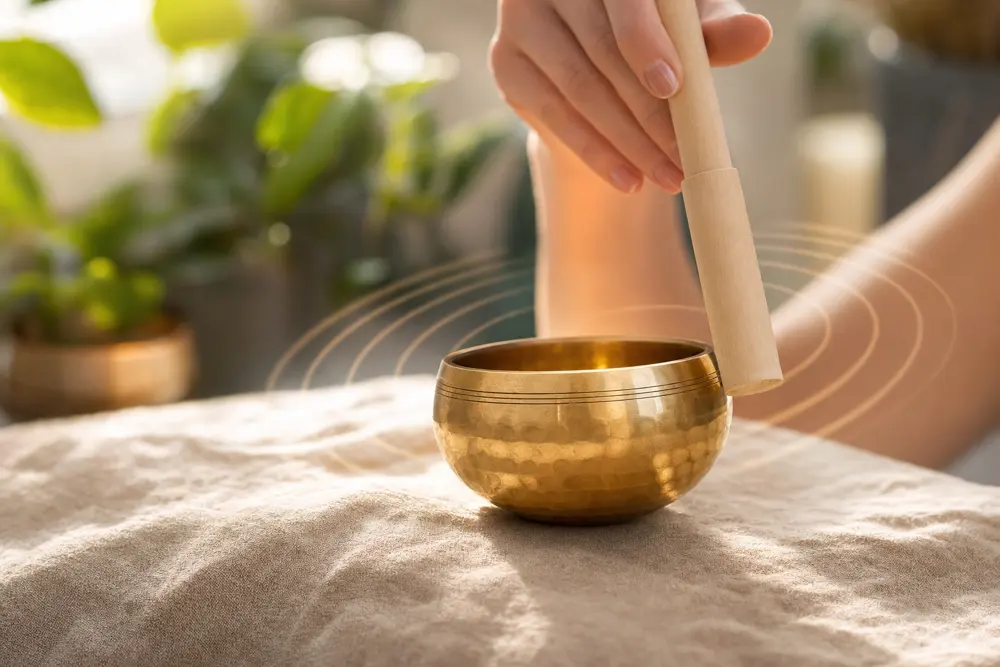
Every singing bowl method you will ever read about is a variation on these two moves. Our 8 cm bowl ships with a wooden mallet that handles both, and the difference between them is the difference between a bell and a voice.
| Technique | How you do it | Sound character | Best for |
|---|---|---|---|
| Strike | Rest the bowl on a flat palm or its cushion, tap the outer rim gently with the mallet, let it ring completely | One clear tone that swells, sustains, then fades over many seconds | Opening and closing a session, pacing slow exhales, quick resets |
| Rim singing | Press the mallet firmly against the outer rim and circle slowly with constant, even contact | A continuous rising tone that holds for as long as you keep circling | The middle of a session and longer stretches of focused listening |
| Strike-then-rim | Tap once, then start circling while the strike tone still rings | A bell tone that blends smoothly into a sustained voice | Moving from settling in to sustained focus without a hard break |
To strike well, keep your fingers relaxed and never wrapped around the wall of the bowl, then tap the outer rim with the shoulder of the mallet. Let the sound decay completely before you strike again; cutting the fade short throws away the most useful part of the tone.
Rim singing takes most people a few sessions. Press the mallet against the outside of the rim with firm, steady pressure and circle slowly, like stirring thick honey. Speed is the enemy here. If the bowl rattles or chatters, you are circling too fast or pressing too lightly, so slow down and lean in. A leather head also warms and rounds the tone of every strike, which is why our leather mallets in three sizes are the most common second purchase from meditators who started with the bare bowl.
A Guided 10-Minute Singing Bowl Meditation Routine
Set a gentle timer for ten minutes or simply follow the minute markers below. The routine leads with strikes because they ask nothing of your technique, then moves to rim singing once your attention has settled.
- Set up (minute 0). Choose a reasonably quiet spot. Sit on a chair or cushion and rest the bowl on your open palm, or on its cushion on a table in front of you.
- Settle your posture. Sit tall but not rigid. Drop your shoulders, unclench your jaw, and close or lower your eyes.
- Take three slow breaths. In through the nose, out through the mouth. Nothing fancy; you are just arriving.
- Strike once to open (minute 1). One clear tap on the outer rim. Listen to the tone all the way into silence without judging how it sounds.
- Strike and follow (minutes 2 to 4). Strike again each time the sound fully fades. Let each exhale ride the fade of the tone.
- Switch to rim singing (minutes 5 to 8). Circle the rim slowly until the continuous tone builds, then hold it steady. If it stutters, slow down, press slightly harder, and keep going.
- Return when you drift. You will drift; everyone does. Noticing the drift and coming back to the sound is the repetition that trains attention, not a failure.
- Strike once to close (minute 9). Set the mallet down after one final tap and follow the tone all the way out.
- Sit in the silence (minute 10). Stay for one quiet minute with no sound at all. This is where the stillness you built becomes obvious.
- Close deliberately. Open your eyes, name how you feel in one word, and put the bowl back where it lives so tomorrow's session has zero setup.
Ten minutes every day beats an hour on Sundays. The routine is deliberately plain because plain is what survives a busy week.
Wooden mallet included · Free US shipping · 30-day money-back guarantee
Which Singing Bowl Should You Meditate With?
We keep the catalog deliberately small: one bowl, one set, three mallets. Mira plays every bowl before it ships, checking strike tone, rim response, and sustain (see how we test). Here is how the options compare for meditation:
| Option | What you get | Price | Best for |
|---|---|---|---|
| Tibetan Singing Bowl 8 cm | Hand-finished brass bowl with hammered texture, 8 cm (3.15 in) wide and 4.5 cm (1.77 in) tall, wooden mallet included | $39.99 | Starting a daily strike-and-listen practice at the lowest cost |
| Singing Bowl Set | Engraved 8 cm bowl, 8 cm silk cushion, and a 12.5 cm (4.9 in) double-headed wood and leather mallet | $49.99 | A complete tabletop meditation corner in one box |
| Leather Mallets | Hardwood handles with leather heads: small 13 × 2.6 cm, medium 18 × 2.5 cm, large head 18 × 4 cm | $14.99 to $24.99 | Warmer, softer strike tones from a bowl you already own |
The bare bowl is the right call if you want the lowest-cost start and have a steady palm or a folded cloth to set it on. The set is what we recommend for a dedicated meditation corner: the silk cushion keeps the bowl stable and lets it resonate freely on a tabletop, and the double-headed mallet gives you wood on one end for bright strikes and leather on the other for rim work and softer tones. You choose one of three engravings, Flower of Life, Auspicious Symbols, or Gold Eye, at secure checkout. And if you already own a bowl, a dedicated leather mallet is the cheapest meaningful upgrade to its sound.
Average rating across 51 verified reviews of the 8 cm bowl
— verified buyer feedback, supplier order history, 2026
Average rating across 57 verified reviews of the complete set
— verified buyer feedback, supplier order history, 2026
Bowl diameter (3.15 in), 4.5 cm (1.77 in) tall — sized to rest on an open palm during meditation
— official supplier dimension sheet, 2026
Before you decide, read the verified buyer reviews: the photos are unedited, and several buyers describe using the bowl for exactly the routine above.
Beginner Mistakes That Flatten the Sound
- Gripping the bowl. Wrapped fingers deaden the wall and kill the sustain. Rest the bowl on a flat palm with fingertips low, or set it on its cushion and let it ring free.
- Circling too fast. Speed produces chatter, not song. Move at the pace you would stir thick honey and let the tone build over several full circles before you judge it.
- Pressing too lightly. Rim singing runs on friction. If the mallet skips or squeaks across the rim, lean in slightly and keep the contact constant.
- Chasing a perfect tone. The sound is the anchor, not the goal. A session where you returned from twenty distractions beats a prettier-sounding session where you gave up in two minutes.
- Starting too long. Thirty-minute sessions on day one usually end the habit by day four. Begin with the ten minutes above and extend only when the timer starts surprising you.
- Treating it as background audio. The bowl is an anchor, not a soundtrack. Give it your full attention for ten minutes rather than letting it ring behind a podcast.
What the Research Actually Says
An observational study published in the Journal of Evidence-Based Complementary & Alternative Medicine (Goldsby et al., 2017) reported reduced tension, anger and fatigue after Tibetan singing bowl meditation sessions. It is a qualitative piece of evidence: participants reported how they felt, without a control group, so we treat it as a promising signal rather than proof.
Observational study reporting reduced tension, anger and fatigue after Tibetan singing bowl meditation sessions
— Goldsby et al., Journal of Evidence-Based Complementary & Alternative Medicine, 2017
Our position at Nadam is deliberately modest. A singing bowl is a durable, beautiful tool for relaxation, focus, and a meditation routine you actually keep. It is not a medical device, and anyone selling it as one is overreaching. If the practice becomes a calm ten minutes in your day, it has done its job.
Who wrote thisReviewed and updated July 4, 2026. Read more about Nadam and the checks behind every bowl we ship.
Singing Bowl Meditation FAQ
How long should a singing bowl meditation session be?
Ten minutes is a comfortable starting point, and it is the length the guided routine on this page is built around. Many practitioners settle at 10 to 20 minutes once the practice feels natural. Consistency matters more than duration: a short daily session builds the habit faster than an occasional long one. Extend the time only when ten minutes starts to feel short.
Should I strike the bowl or make it sing during meditation?
Use both. Strikes suit the start and end of a session because each tone rises, sustains, and fades on its own while you simply listen. Rim singing suits the middle, since the continuous tone holds your attention for minutes at a time. If you are brand new, spend your first week on strikes alone, then add rim work once sitting still feels easy.
Can I meditate with a singing bowl as a complete beginner?
Yes. A singing bowl actually makes meditation easier for beginners because it replaces a vague instruction like "clear your mind" with a concrete one: follow this sound. The Nadam 8 cm bowl arrives with a wooden mallet and produces a clear tone on the first strike, so there is no technique barrier to starting the day it arrives.
What size singing bowl is best for meditation?
For seated meditation at home, a palm-sized bowl is the practical choice. The Nadam bowl measures 8 cm (3.15 in) across and 4.5 cm (1.77 in) tall, rests comfortably on a flat palm or its cushion, and responds easily to both strike and rim technique. Larger bowls produce deeper tones but are heavier to hold and slower to answer the mallet.
Something we did not cover? Ask us directly — a real person answers every message.
Make Tonight's Ten Minutes Quieter
Everything above works the day your bowl arrives, mallet included. If the routine does not stick, send it back within 30 days.
Free US shipping (7–14 business days) · 30-day money-back guarantee · Secure Stripe checkout