
· Mira Chandran
Large vs Small Singing Bowl: Which Size to Choose
Size is the first question readers send me and the last thing most shops explain honestly. I play every size Nadam sells before it earns a place in the catalog, and I have played plenty we will never sell, from palm-sized minis to bowls wide enough to need their own floor cushion. The short version: diameter decides the voice, the price, and whether the bowl actually gets used. Here is the full comparison, plus how to pick your diameter from the seven we sell. If you are brand new to the instrument, skim our guide on how to use a singing bowl first and come back.
How Size Changes a Singing Bowl's Voice
Think of a singing bowl as a brass bell turned upward. Wide, heavy walls move slowly when struck, so the pitch drops, the note builds gradually, and the sustain stretches out. Narrow walls snap back quickly: the note sits higher, speaks immediately, and settles sooner. That is why a small bowl feels crisp and wakeful while a large one feels grounding, and why neither is "better" — they are different instruments doing different jobs.
Two more things shape the voice. First, wall texture: our bowls are hammered brass, and no two hammered walls are identical, so two bowls of the same diameter never sound exactly alike. We dig into why that matters in hand-hammered vs machine-made singing bowls. Second, the mallet you pair with the bowl, which matters so much it gets its own section below.
Singing Bowl Sizes Compared: Small, Medium, Large
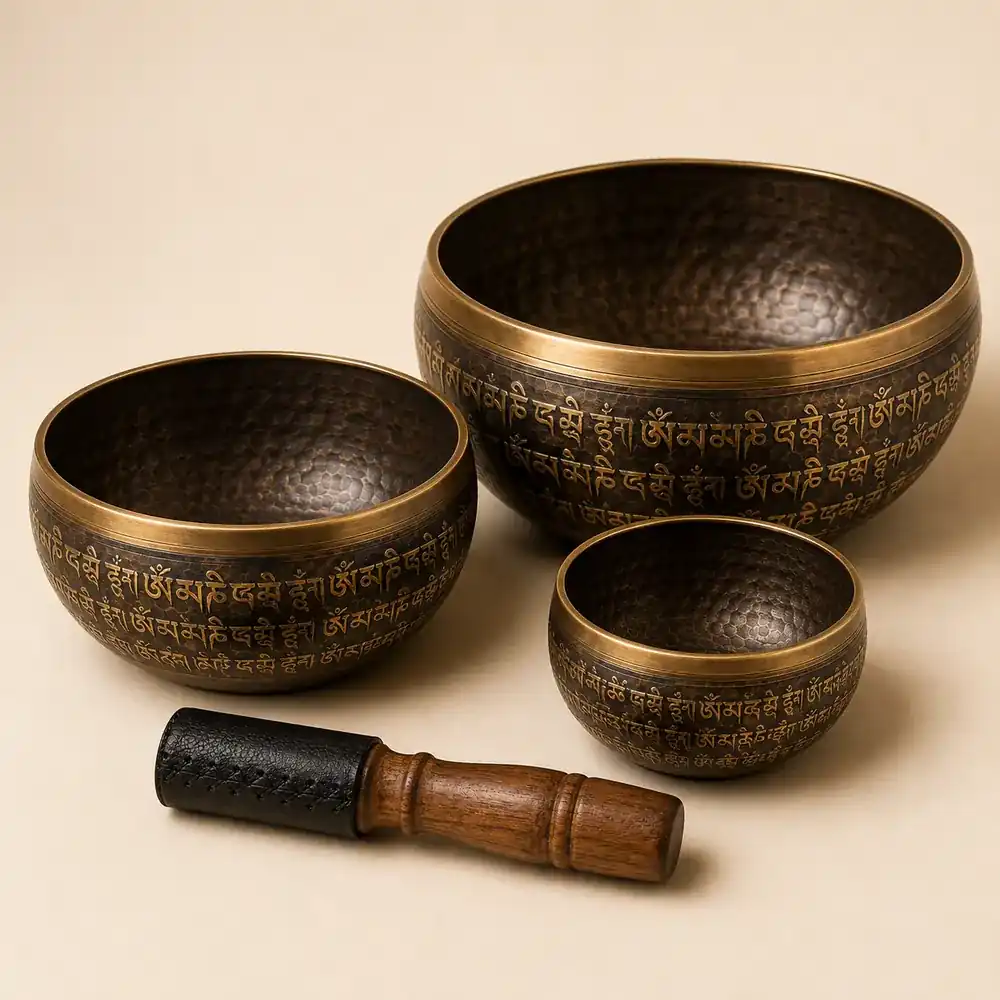
| Trait | Small (3.1–3.5 in) | Medium (4.3–5.3 in) | Large (5.9 in and up) |
|---|---|---|---|
| Voice | High, bright, clear strike tone | Fuller, rounder, warmer | Low, deep, room-filling |
| Sustain | Short to moderate | Moderate | Long, slow bloom |
| Best for | First bowl, desk or nightstand, travel | Lap playing, longer solo sessions | Sound baths, groups, low tones |
| Handling | One hand or fingertips | Open palm or lap | Two hands, floor or large cushion |
| Budget | Most affordable — our 3.1 in bowl is $39.95 | Mid-range | The biggest investment |
| Mallet pairing | Small leather mallet, 5.1 × 1 in | Medium mallet, 7.1 × 1 in | Large head, 7.1 × 1.6 in |
Treat the boundaries as fuzzy: a heavy-walled 4 in bowl can sound rounder than a thin 4.9 in one. As a buying shorthand, though, diameter is the most reliable signal you have when shopping online — far more reliable than product photos, which rarely show scale honestly.
Small Singing Bowls (3.1–3.5 in): Bright, Portable, Beginner-Friendly
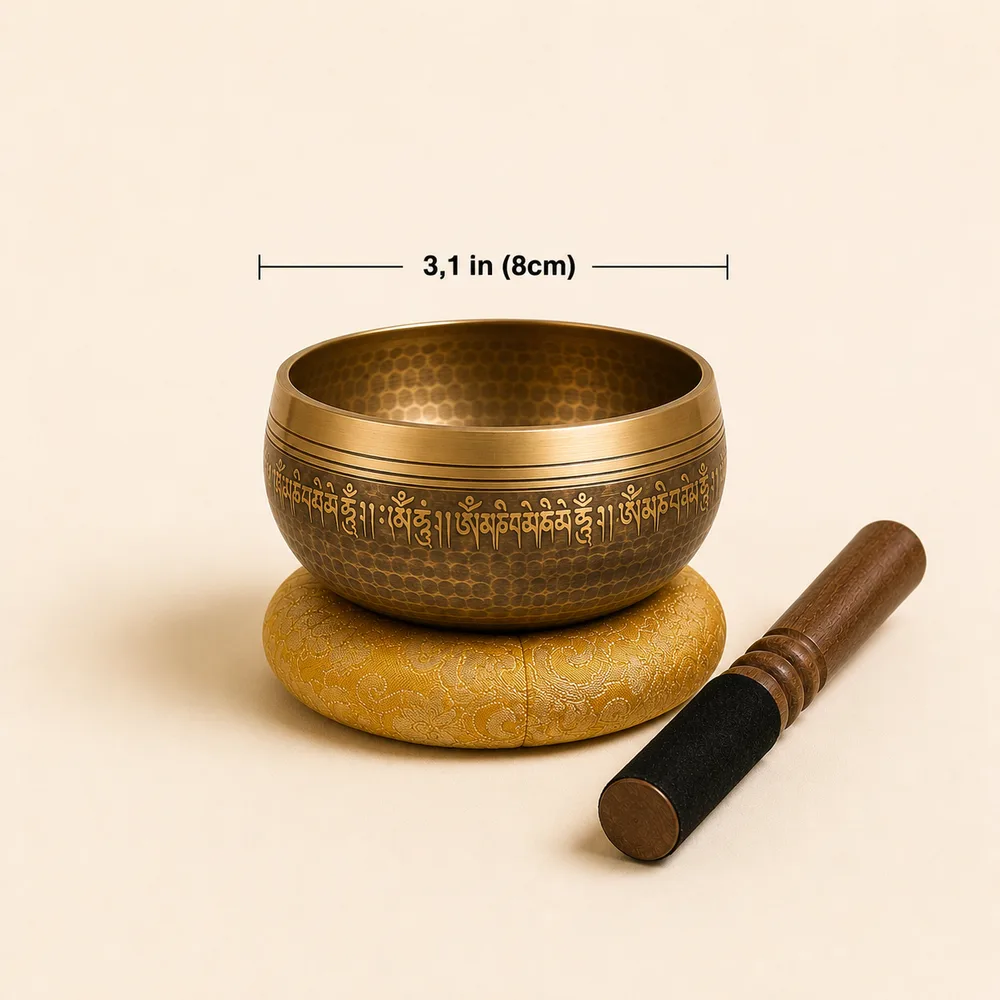
Our 3.1 in Tibetan singing bowl is exactly this class of instrument: 3.1 in (8 cm) across, hand-hammered brass with engraved mantras, and a mallet and cushion in the box. At $39.95, down from $59.95, it is the least expensive way we know to put a genuinely good-sounding bowl on your desk. Struck on the rim, it gives a clear, bright note that settles quickly — ideal for opening and closing a short meditation, marking the start of a focused work block, or taking one slow breath before bed.
Average rating across 361 verified purchases of the 3.1 in starter set
— Nadam verified order history, 2026
Two things to know. A small bowl puts its energy into a bright, clear voice rather than low-end warmth; that is physics, and it is what makes it cut through a quiet room. And rim singing, circling the mallet to build a continuous tone, takes a lighter, faster touch on a small rim than on a big one, which is a knack you pick up in a session or two. What you get in exchange is an instrument you can hold in one hand, pack in a carry-on, and keep within arm's reach. That reach is exactly why small bowls get played daily while big ones too often become shelf sculpture. You can see how real buyers photograph and describe theirs on our reviews page.
Medium Singing Bowls (4.3–5.3 in): The Versatile Middle
Medium is the size many people step up to once they know they will actually practice. The voice gains body, the sustain stretches, and the bowl still travels and still fits a bookshelf. If you play for a partner or a small room, 4.3 to 5.3 in is a sweet spot.
We stock this middle ground properly: the 4.3, 4.9 and 5.3 in bowls all sit in it, from $69.95 to $89.95, each with its leather mallet and cushion. If you are stepping up from a small bowl rather than buying your first, this is the range to read twice before choosing.
Average across 361 verified purchases of the engraved Singing Bowl Set
— Verified buyer feedback, verified order history, 2026
Large Singing Bowls (5.9 in and Up): Deep Tones for Sound Baths
If you have ever lain on a mat while someone played a wide bowl near your feet, you know why practitioners carry them: the tone rises slowly, holds, and seems to come from everywhere at once. For group work, that presence is worth every trade-off.
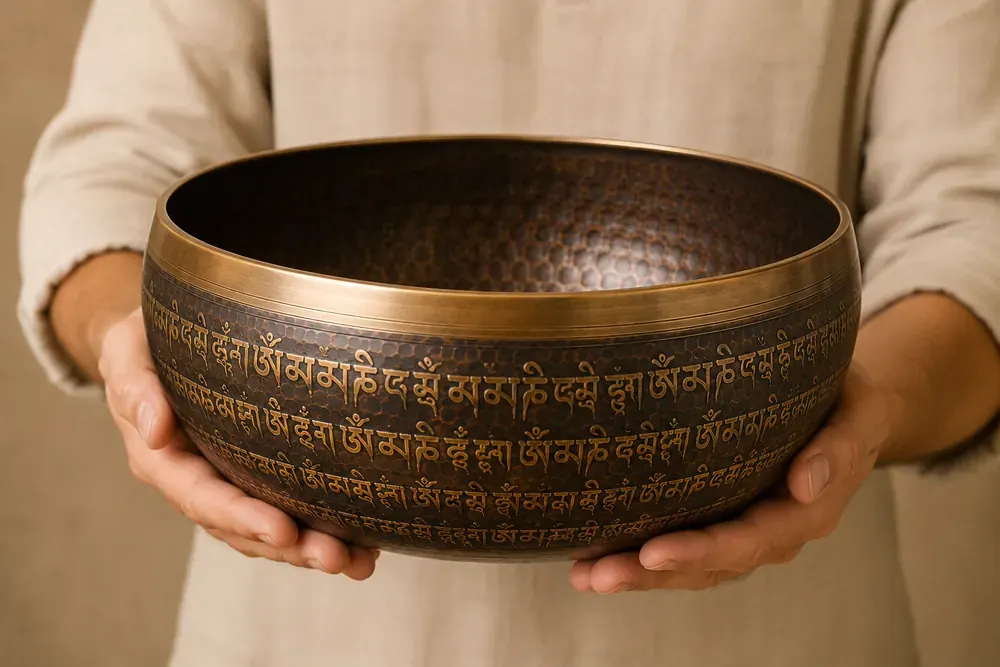
— Verified buyer · Canada, 6.7 in bowl. Each cushion is paired by hand with its bowl; this one arrived pink.
And the trade-offs are real. Large bowls use far more brass and far more finishing labor, so prices climb steeply with diameter. They are heavy enough to want two hands and a dedicated cushion, awkward to travel with, and unforgiving in a small apartment. My rule: go large when you are hosting others or building a dedicated corner — our walkthrough on setting up a sound bath at home covers the layout — and stay under 5 inches if the bowl's job is a daily personal cue. Either way, the fundamentals in our singing bowl meditation guide apply at every diameter.
How to Pick Your Diameter
Every size goes through the same checks — strike tone, rim response, sustain, how the bowl sits on a cushion. The full checklist lives on our how we test page. What the range taught us is that the choice splits cleanly in three. Under 4 inches, you get an instrument that lives where your pauses actually happen: a desk between meetings, a nightstand before sleep. The bowls that get played are the ones left out in sight, and a small bowl is the easiest to leave out.
Between 4.3 and 5.3 inches sits the range most people end up keeping. The rim is wide enough that circling stops being fiddly, the note holds long enough to sit with, and the bowl is still light enough to pick up without ceremony. If you are buying one bowl and want it to do everything, this is where to look.
At 5.9 and 6.7 inches the instrument changes character. Wider walls vibrate more slowly, so the tone drops and the sustain stretches out. You feel these bowls as much as you hear them. They are heavier, they want a dedicated spot rather than a handbag, and they cost more because they use more brass and more finishing work — but nothing smaller reproduces that low hum. If you are hosting others, this is the end of the range you want.
The seven diameters we sell (8 to 17 cm), from desk-sized to sound-bath sized
— Nadam dimension sheet, 2026
There is encouraging, if early, research context too: an observational study published in the Journal of Evidence-Based Complementary & Alternative Medicine (Goldsby et al., 2017) reported reduced tension, anger and fatigue after Tibetan singing bowl meditation sessions. That is observational rather than clinical proof, but it matches what practitioners describe — and a bowl you touch every day supports that kind of routine better than one you keep stored. You can read more about who we are and how we choose what to sell in the Nadam story.
The Mallet Shapes the Sound as Much as the Bowl Size
The mallet included with every bowl is all you need to start: wood on brass gives the brightest, most direct strike. Leather changes the character. A leather head cushions the first contact, softens the attack, and lets more of the bowl's lower, rounder voice come through — which is why players reach for bigger, leather-wrapped heads as bowls grow.
Our leather singing bowl mallets come in three sizes, each a hardwood handle with a stitched leather head. Small (5.1 × 1 in, $14.95) is sized for the 3.1 to 4.3 in bowls. Medium (7.1 × 1 in, $19.95) is the versatile pick if you play several bowls. Large head (7.1 × 1.6 in, $24.95) coaxes the deepest, most rounded response from bigger bowls. A practical pattern many players settle into: strike with the wooden end for a bright, direct tone, then switch to the leather head for rim singing, where the softer surface helps the tone build and sustain.
Average across 23 verified reviews of our leather mallet line
— Verified buyer feedback, verified order history, 2026
So Which Singing Bowl Size Should You Choose?
If you are still torn, buy the size that matches your space, not your ambition. A bowl that lives on your desk will teach you more in a month than a big one you unpack twice a year. Start small, learn the rim, and let a larger bowl be the reward for a practice you have already built. Every Nadam order ships with free shipping (6-10 business days) and a 30-day money-back guarantee, with secure Stripe checkout.

Mira Chandran · Sound practitioner & product lead at Nadam
Mira has been leading small-group sound baths for years. She plays every size Nadam sells — strike tone, rim singing, sustain, how the bowl sits on its cushion — before that model earns a place in the catalog.
Prefer the full ritual? Bring the Set Home — $39.95 →